Saturday, 28 January 2017

Another full day birding!!


I managed another full days birding today! The Mrs and the kids all had plans that involved friends and not me so I had a full day pass!!

For a while I had been planning on visiting a few coastal sites in North Wales.  Alan Davies, he of the biggest twitch fame and tour leader with bird watching trips wrote a feature in Birdwatch magazine suggesting a number of sites worth a visit in autumn. I know its hardly autumn but I decided I'd give it a go anyway. I had no intention of visiting all the sites in Alan's itinerary and if I'm honest I was mainly just after seeing some species I don't see very often, namely Slavonian Grebe, Red-necked Grebe and Red-breasted Merganser. 

The most likely looking place based on Alan's article, and from info on twitter was Llanfairfechan. The tide looked good and was at a reasonable time so at 08:00 this morning I was Wales bound! 

The journey takes around 1 1/2 hrs so it was just before 10.00 when I arrived - needed a bit of breakfast en-route. The car park at the promenade is brilliant. You can reverse your car into the parking spaces and sit with the boot open and scope in front of you while you scan the sea. Proper armchair birding. Plus its free parking - English coastal towns take note please.

My view from the car park


Straight away it was obvious there was a good number of Great Crested Grebes about which inspired confidence that the other two target Grebe species might be around. There was a good number of sea duck out on the horizon which I assumed were Common Scoter, and a few flocks that came closer in were all that species. A nice surprise was a couple of Long-tailed Duck that gave a nice but distant flypast. I don't think I've ever seen as many Red-throated Divers in one place. There were numerous singletons plus flocks of five and six plus a huge (for me) flock of 16 flying out on the horizon. I thought I had two Slavonian Grebes in flight, but they to were distant and I couldn't hand on heart say they were definitely Slavonian.

I sat at the back of my car until around midday when it started to quieten down, and then went for a walk westwards along the coast towards the small salt marsh area. There were numerous Oystercatchers along the beach but no Snow Buntings - something I thought might have been a possibility. The salt marsh is a gem of a spot. Wigeon, Pintail, Teal and Curlew were all there in numbers plus a few Knot and Redshank. Just off the marsh small parties of Red-breasted Mergansers were loafing around. A great little spot.

Cheeky Jackdaw - love their blue eyes


Red-breasted Mergansers


Wildfowl City


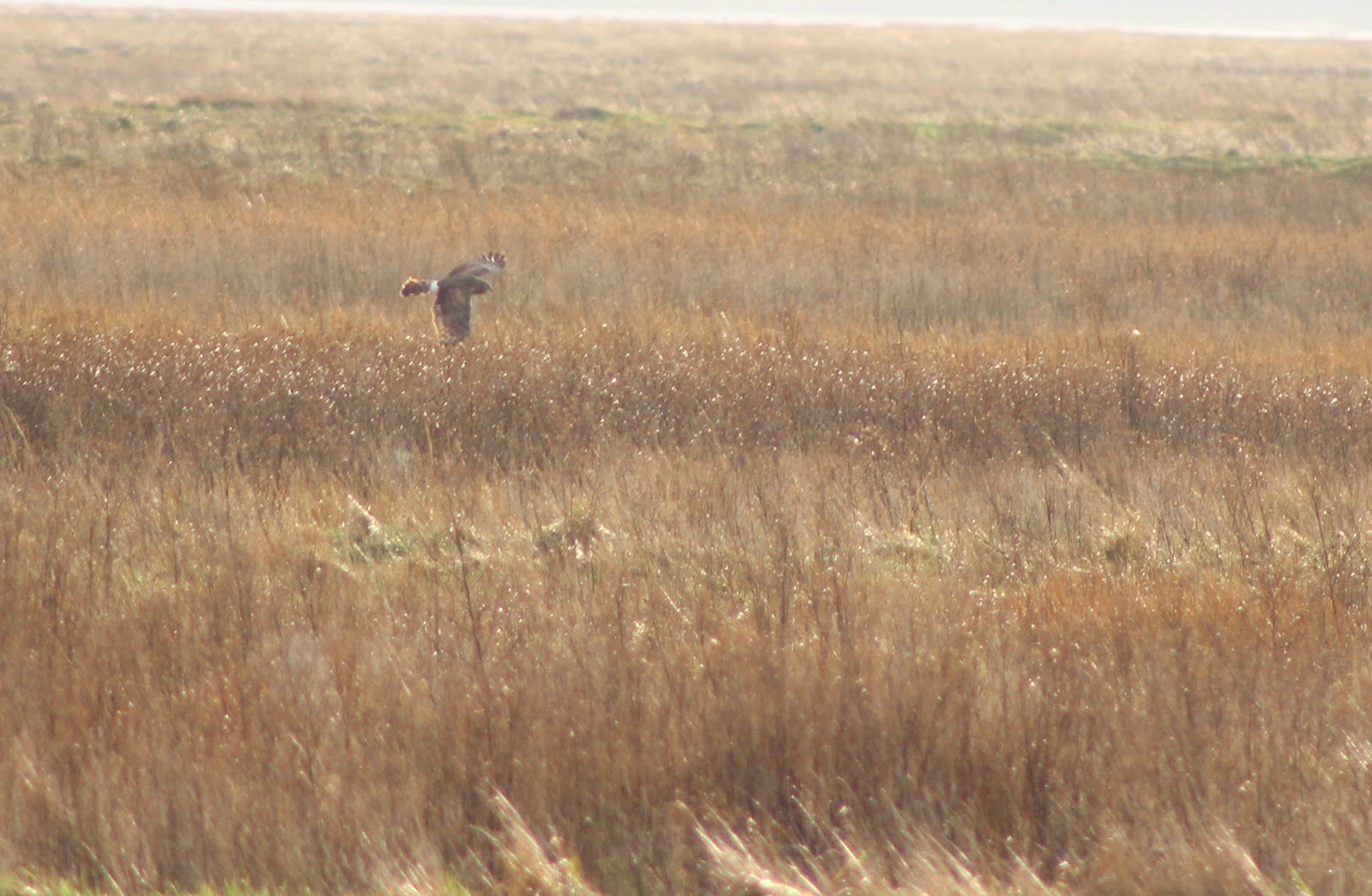
By this time it was around 1pm and I needed to be heading back in a homeward direction to be sure I was back for the kids at tea time, so I decided I'd call in at Parkgate to see if there was any Harrier action. I wasn't to be disappointed. I arrived at 2.15pm and immediately noticed what looked like a 'ring tail' harrier quartering the marsh. I quickly grabbed my bins and scope out of the boot and had good but distant views of a Hen Harrier. A little later a Marsh Harrier put in an appearance, and at one point I had both Hen and Marsh Harrier in the scope at the same time. A little later and a second Marsh Harrier was found further to the north and I picked out a very distant Peregrine perched up on an old tree branch out in the estuary. Sadly virtually all the birds were too far away for any good shots but the Hen Harrier did a reasonable flyby that allowed me some record shots, and the phonescoped Peregrine at least looks like a Peregrine. Well to me it does. 

Ring tail Hen Harrier


Hovering Harrier


Distant Peregrine

 Sunset at Parkgate

Spurn

On 26th January East Yorkshire council approved the new Yorkshire Wildlife Trust visitor centre at Spurn. To say I feel annoyed or disappointed would be a huge understatement. Furious comes closer. But its done and there's not a lot I, personally, can do. It does raise a number of very interesting questions. Some would probably get me in trouble if I posted them, so I won't.

I still cannot believe that YWT have pursued this option, and that EYC have approved it despite, in my opinion, obvious conflicts with their own planning policies, and after rejecting an almost identical plan just a few months ago.

Thats enough whingeing. I'm just getting angry again.

I know a number of existing YWT members have now cancelled their membership of YWT. If thats you, can I suggest you now join Friends of Spurn? Its a lot cheaper and they will re-invest your money in habitat creation and management and providing facilities through the superb new Observatory building (developed in an existing property I should add). You get access to member only areas, and you get the top quality annual report free of charge. There's no down side. In fact even if you don't cancel your YWT membership, why not join Friends of Spurn as well anyway?

Sunday, 22 January 2017

A Wild Goose / Duck / Gull Chase

I took the day off work on Friday to do a bit of birding. I wasn't exactly sure where I was going to go; I thought about the Dusky Thrush, but last time I headed that way during the week the traffic was horrendous so I chickened out. Ditto the Blue Rock Thrush. The Black-throated Thrush at Adwick was a definite contender but there was no early news so I wasn't going to risk it. I also considered my annual trip to Martin Mere where a Green-winged Teal had been putting in an odd appearance, but that was all so I decided against that too. Instead I decided to go up to the Fylde coast at Cockerham to look for the Red-breasted Goose that has been hanging around recently with the Pinks and a few Bean Geese. It wasn't that early when I arrived - probably around 08.15 - and straight away I noticed the wildfowlers had been out. They were stood at their usual parking spot obviously having finished the morning flight. I hadn't seen any geese in the fields and suspected that the shooting would have kept them off, so I turned around and went up to Thurnham where there had also been reports but again no joy. I headed back to Cockerham to see if the geese had started to settle now the wildfowlers had finished but again no signs of any geese in the fields! A little bit out of desperation I headed to Fluke Hall, an area where I've never seen anyone shooting and sure enough I found a sizeable flock of Pink-feet feeding in a distant field. Viewing was difficult as there was a hedge between us, but after spending 20-30 mins I was fairly confident I'd seen all the birds and there was no Red-breasted Goose, or Beans with them. I gave up! A quick check of twitter didn't inspire me, and with no high tide to wait for I went with my other option for the day - Martin Mere.

It took about an hour to make the journey, so I arrived just before lunch. As usual I headed straight for the Ron Barker Hide. There was a good number of Teal on the pools but after scanning several times I couldn't find any sign of the Green-winged Teal, and there were no reports from other birders either. However a Water Rail put in an appearance, as did a Marsh Harrier. After two hours enough was enough and rather than spending more time on the site I headed off to Pennington Flash to do the gull roost. A highly unusual thing for me to do.

At 3.15 I was on the south bank of the flash scanning the gulls in the hope of one of the white winged species that have been present sporadically. I was joined at about 3.30 by another Pennington regular which made the experience much more enjoyable!! An adult Mediterranean Gull was the star of the show. The large gulls were quite few in number, and the main Black-headed roost was, unusually, tucked right under the north bank instead of in the middle which made checking all the birds in that group very difficult.

Phonescoped Adult Mediterranean Gull


We also had a very unusual, very small Herring Gull. We did wonder whether we had a Ring-billed Gull. Quite a few features seemed to fit quite well, so we sent some images and some notes to the county recorder who's a bit of a Gull expert, but unfortunately he reckoned it was just a very small Argenteus Herring Gull. Disappointing but at the same time working through his comments was educational. I really should get into gulls. They provide some really challenging birding.

Sunday, 4 December 2016

End of Autumn

So, that's it. autumn is over and so is the autumn migration. I cant complain. Its been one of the best autumns I've had in ages (bird wise anyway - on a football front its been pretty painful watching the latics). I had a fantastic time in October at Bempton and Spurn, ticking off six lifers I think. And, although it never feels as good back on the western side of the country, I have managed to add a couple more life, site and year ticks to my various lists. Long-tailed Duck and Red-throated Diver at Pennington Flash were long overdue site ticks, the former was also a year tick, and a Scaup a couple of weeks ago was also a year tick.

Sadly nowhere is really getting that many good birds at the moment, so I've been out and about trying to find my own stuff. Unfortunately with no success. Last week I went out to the Wirral and, despite a stunning but cold sunrise, the entire Wirral was fog bound with visibility down to a couple of hundred metres at best, as you can see below.


I did enjoy watching the few waders that were close in though, particularly the Sanderling and Turnstones. I tried to phonescope the former with limited success - they just will not stand still.

 
Other than that, I've been spending time at Pennington Flash. Just a few hours on a Saturday morning. The birding has been slow, but its been great to catch up with some of the regulars, most of whom I don't see very often these days except in Horrock's Hide. This Saturday it was at least enlivened by the still present Long-tailed Duck and three Scaup (picture below), plus good numbers of other wildfowl, including what is probably my favourite 'freshwater' diving duck, the Goldeneye.


Again I spent a bit of time phonescoping. The above images aren't great, but they're better than the ones I took a few months ago, so I'm getting there. Just need to keep practicing.

Wednesday, 9 November 2016

Objection!


So, Yorkshire Wildlife Trust have decided to resubmit their controversial plan for a visitor centre at Spurn, despite the East Riding Planning Committee refusing it last time on landscape impacts and flood risk grounds.
I will say again I am not against a centre at Spurn, but the location is wrong, very wrong in my opinion. So I've put together yet another objection. As my objection will be published on the East Riding Planning Portal, I guess there's no harm putting it on here either. Its rushed this time, as every time I have been on the East Riding planning portal something has gone wrong and I've not been able to see the documents until tonight. Still, it will still register my objection even if I haven't quite managed to bottom out all the nitty gritty of the facts and figures.

I guess there's also a risk my interpretation of some of the detail might be a bit out (so bear that in mind when you read it), but its not like I'm a statutory consultee, and this is where a planner comes in - its their job to sort the wheat from the chaff. And, ultimately it shouldn't matter whether I have it all there or not. If the proposals are not in line with the East Riding planning policies it shouldn't be approved. Whether the planner and the committee agree with my interpretation of their policies and the application only time will tell.

Anyway, here it is


I am writing to object to the proposed visitor centre at Spurn, Kilnsea, as proposed by the Yorkshire Wildlife Trust (YWT). I am not a resident of Kilnsea, but have visited regularly (twice a year or more) over the last twenty years.

 My objection and the reasons behind this objection are outlined below. Given that the new proposals do not differ dramatically from the previous plans, I have listed Landscape and Flood Risk as my first reasons for objection as these where the reasons the plans were refused previously. However, all other aspects of my objection still stand.

Landscape: I object to the impact that the proposed centre will have on the visual and aesthetic quality of the area. The proposed visitor centre will be located in an area that YWT believe will have no visual impact on the landscape. However it is quite clear from the YWT Visual Impact Assessment that the centre will be visible from most directions, and is only really screened when looking north from the area of the current ‘Spurn gate’. The associated Radar tower appears to have been removed from these proposals however this does not considerably reduce the visual impact. Not only is the proposed centre visible it is not in keeping with the style of building(s) frequently encountered along this area of coast, or indeed in the wider coastal environment. The council have clearly stated their approach to impacts on landscape on the coast around Spurn in Policy ENV10 of the Local Plan which states that development must “…not adversely affect heritage features, natural coastal processes, flora and fauna, the coast or access to it by reason of scale, siting, design, noise disturbance or traffic. Proposals involving other land uses are covered by other policies in this Plan”. This policy also states that “Proposals for development in the estuarine coastal area will only be approved if Policy Env5 is satisfied.” This latter point is addressed below.

The policy document also specifies that Aim 1 of the council is to “…preserve and enhance those features of the environment that make a positive contribution to the character and appearance of Holderness….”. In addition, whilst the council clearly states its position on tourist facilities in Policy TM1 this policy is clear that these facilities must “…fall within the established centres of population where they, meet the needs of residents and visitors, do not adversely effect the character and amenity of the area or place unnecessary burden on the established services and infrastructure.” I understand that other consultations have raised the issue that roads would need to be widened to accommodate the additional traffic, and the potential for double yellow lines to be needed has also been raised. Both would be a clear breach of this policy. Section 2.4.15 of the local plan also states that Holderness has experienced the recent development of Environmental or "Green" tourism reflecting national trends and societies increasing concern for the protection of landscape and nature conservation interests. Particular attractions in Holderness include the Spurn Heritage Coast…The Council will encourage the development of tourism in association with the areas environmental resources however, at the same time will ensure that new development does not harm the environmental resources themselves through the removal of their nature conservation or scenic value.” Section 2.1.24 states that the council “…wishes to discourage the encroachment of development into the open countryside.” and under the coastal zone policies the Council identify the value of the coastal landscape and the need to protect and value this area.

 I believe that given the information provided in this application, the current proposals clearly conflict with current policy due to the size, design and location of the proposed centre and car park. There are clear alternatives that provide viable options if not necessarily the applicant’s first choice.

Flood Risk: The applicant does not sufficiently demonstrate how they will mitigate for the risks associated with visitor safety on the site. The proposed centre would be extremely isolated should tidal flooding occur, whereas other sites, eg Southfield Farm are located closer to evacuation routes. Similarly, the applicant’s assertion that it is “difficult” to flood proof existing buildings is not exactly true and there is no indication that the applicant has investigated what flood proofing these other buildings would require in order to come to that decision. The site at Southfield Farm opposite the Bluebell did not flood during the recent tidal surge and so may require less flood protection than that suggested by the applicant and I understand this has been offered to the applicant.

 The sequential test used by the applicant with regards to flood risk points out that other sites would conflict with current planning policies, however they fail to mention that their chosen site also conflicts with the majority of these policies, plus additional ones.

 The applicant states that Kilnsea Wetlands would be unsuitable due to land being allocated to mitigation for the loss of Beacon Lagoons. From information here http://www.tide-toolbox.eu/measures/kilnsea_wetlands/habitat_creation_area_discription/ the plans suggest that area X is not allocated for any habitat creation other than a pond dipping pond. They also state that this site would have visual impacts, which can equally be said of their preferred location. Although YWT only lease land at Kilnsea Wetlands, there is no indication they have spoken to the Environment Agency to establish whether construction of a centre here would be feasible.

Nature Conservation: I object to the development due to the impacts on nature conservation. The council clearly sets out its stance regarding nature conservation in Policies ENV1 to ENV40. This section of the plan also establishes that the Council recognises that it has a major role to play in conserving the landscape. In section 2.1.14 the local plan states that issues needing to be addressed by the plan include: “The sea and estuary coasts need to be protected from unnecessary and inappropriate development, Identification of natural features which are important and irreplaceable and to protect them against development, and identification and protection of features of archaeological, historic and architectural importance from the effects of inappropriate development, and ensure that new development where it is appropriate is designed to have a minimal adverse impact on such features and to enhance them wherever this is appropriate”. The plans for the visitor centre and associated car parking and mitigation do not appear to comply with the policies outlined in the Local Plan, nor is it clear how the YWT plan to ensure that these policies are met, or how they will deliver a number of actions.

 With regards the Biodiversity Report, whilst the authors have clearly followed the standard approach to establishing the value of the site, they have paid little attention to the main biodiversity value of the site in question - its value to migratory birds. Whilst these impacts may be hard to establish, the report does not even attempt to describe the value of the site, the numbers of birds passing through or using the habitat or the potential impacts of the development on these. Much of the data needed would probably be available from the Spurn Bird Observatory, or if not it should have formed at least part of the monitoring of the site. The proposed site provides a valuable stopping off point for significant numbers of migrant bird species and habitat loss and increased disturbance will be detrimental to these species. Whilst I accept that migratory birds have limited protection compared to breeding species, to largely ignore these at a site that is arguably the most important migration route in the UK is inexcusable.

 Once again the figures quoted in the biodiversity enhancement plan do not add up and, given the lack of detailed drawings it is impossible to include conditions to ensure the proposals are met. It appears that most of the mitigation would be delivered in Clubleys field, however most of this habitat is already present and therefore the proposals do not appear to match with the figures quoted in the Biodiversity enhancement plan. The landscape enhancement plan for Clubleys field suggests that there would be scrub planting, however scrub is already present where the trust are proposing this measure, meaning this should not be considered as mitigation or an enhancement. In addition, many of the other proposed enhancements have already been carried out, or relate to proposals such as fencing. These are not suitable or appropriate mitigation measures.

 Any habitat created in the Clubleys field and Warren area could only be considered as temporary. The YWT Flood Risk Assessment establishes that coastal erosion at the proposed centre location will reach the set-back defence line within 40 years. This line would see the current Warren area lost well before 40 years as the area is already much closer to the sea. This would render the majority of the mitigation irrelevant much sooner than the visitor centre life expectancy.

 Regarding the impacts on the SPA and associated bird species. The YWT have identified a number of wader roost sites, none of which appear to be in front of the proposed centre. This is in conflict with the results of other recent documentation, namely the Associated British Ports MER document from the ABP road application in 2013, which clearly indicates a wader roost directly out from the proposed visitor centre site. There are several possibilities, however all point to only one outcome. If the roost has been missed by the report author or appointed surveyors, the fact it is present in another recent document suggests that there is at the very least, uncertainty as to the presence of the roost site. If the roost site has moved, it suggests that the roost sites used by wading birds of the estuary, and associated with the SPA, are not fixed and therefore prevention of disturbance cannot be guaranteed as the location of the roost cannot be guaranteed. However the information is interpreted it raises doubts over the impacts on the roosting waders, and therefore potential impacts on an interest feature of the SPA. Under the Habitats Regulations, where adverse effects cannot be ruled out, a plan must not proceed.

 Policy ENV 5 states that Nature Conservation policies must be satisfied, whilst policy Env11 states “Proposals for development in the estuarine coastal area must accord with Env5 and the other nature conservation policies of this plan. The Council will require a comprehensive scheme to accompany significant estuary related proposals, including environmental measures to safeguard environmental features of importance”. I do not believe that these requirements have been met, or at the very least there is sufficient doubt over their compliance with Habitats Regulations and the delivery of mitigation that the scheme should be refused.

 Policy ENV 9 also references the need to protect the Heritage Coast, of which Spurn is a part. This policy specifically states that the the Heritage Coast Policy is to “…..to conserve, protect and enhance the natural beauty of the Spurn Heritage Coast, including its terrestrial, littoral and marine flora and fauna, and its heritage features of architectural, historical and archaeological interest…” I do not believe that the construction of a permanent 6m high visitor centre and pay and display car park is in keeping with that policy.

 Access: There is a significant risk of disturbance to wildlife and local communities by increasing visitor numbers. The YWT Access document provides as much argument for not building the centre as it does supporting its construction. As the document states, visitor numbers have dwindled dramatically since the breach of the peninsula. However, the YWT state that activity is now focussed around the Warren area. Whilst this is true there are several things to consider. Firstly, as the YWT control access to this area from the ‘Spurn Gate’ they have the ability to control this access by simply closing a gate. Similarly, they could use YWT staff to control the parking etc at the Warren. They have done neither. The majority of people park at the Warren and then move off into the Triangle area, the area that the YWT propose to move their centre to. If the current 20,000 visitors are providing significant disturbance then how, by constructing a centre in the middle of the area they wish to protect, and increasing visitor numbers to in excess of 50,000, do YWT propose to protect the area? Arguably they would be better trying to accommodate the current visitors to the site. Many of the things that the YWT state that they will do ‘if’ they are given permission should have been done years ago if they were a problem. Most could be done with limited investment. For example, the proposed viewing screen at the Warren to prevent disturbance. Since I began visiting the site in 1996 there has been no screen. A screen is relatively cheap and simple so why has one not been provided before now?  

 Essentially the access documents simply demonstrate that the YWT believe that they could attract more visitors if they had a new centre, whilst at the same time arguing that the current visitor numbers are unmanageable. Considering spurn and the YWT proposed centre are at the ‘end of the road’ exactly how is this a ‘Gateway Centre’ so desired by the trust. If the site is so sensitive, why make it into a gateway site?

Aside from the counter arguments within the documents, the statements do not provide any confidence that YWT would be able to deal with increased visitor numbers. Apart from a bit of signage and restricting some access there is no indication that they would have increased staff presence other than, presumably, visitor centre staff. There is therefore a considerable risk of disturbance to both the wildlife of the area and local communities.

The access statements also suggest that the plan is to make Spurn more like a Fairburn Ings or Blacktoft Sands. They want to make it a visitor destination with guided paths and restricted access. Whilst I can appreciate that some restricted access may be beneficial, in 20 years of visiting the site I have never witnessed anyone trespassing or wandering off rights of way. This approach would, in itself, detract from the whole Heritage Coast ethos and result in the area becoming anything but the environment that it is now.

Finally, I am not against the provision of visitor facilities at Spurn. There are however other, better alternative locations or options.

 
Sorry about the small font - for some reason the blog didn't like me copying and pasting from another programme.


Saturday, 29 October 2016

Leighton Moss

I love Leighton Moss, but not usually on a Saturday. RSPB Reserves on a Saturday are always a dichotomy. I think its great so many people want to interact with nature, and the RSPB certainly help them do that. But, when all I want is to do a bit of birding they can be purgatory on a weekend. However! Leighton Moss had a bird I wanted to see - an American Wigeon, so I reckoned if I was up and out early enough, I could beat the crowds, see the bird and be gone before most casual visitors arrived.

It wasn't a great start as I turned the alarm off at 06.30am and promptly went back to sleep, only to wake up 30 mins later cursing. Still, I was on the road by 07:30 and around an hour later I was on the car park. I grabbed my gear together and headed off for the Lower Hide where the bird was last reported from. The walk down was pretty quiet; there was the usual gaggle of 'togs' at the grit trays, hogging the best viewing spot - I don't think they've moved since I was last here in spring. They really should think about moving as I heard several Bearded Tits 'pinging' close to the path on the way up to the hide, and I'm pretty sure if I'd spent five more minutes looking I'd have seen them. But, I was on a mission so, made a mental note to take my time on the way back.

When I arrived at Lower Hide I was the only person in there. A quick look out of the windows provided a potential reason for that. The pool was covered in mist and viewing was down to perhaps 50m max. So it was a case of sitting and waiting. A few other birders came and went and slowly the mist cleared. When it cleared enough to see the back of the pool there was only me in the hide, so I had the joy of finding, and enjoying, the American Wigeon on my own. It really stood out more than I expected - the creamy-buff forehead was like a beacon in the gloom left behind after the mist. Eventually it showed really well, and a few more birders turned up to enjoy it too.

The view from Lower Hide  just as the American Wigeon decided to show. The Wigeon is in this photograph - If I could work out how to put an arrow on I'd point it out!


Other entertainment was provided by a showy Water Rail and a few fleeting glimpses of a Bearded Tit. It was also nice to see lots of Pintail too, probably more than I've seen here ever before I think. Sadly the weather and the distances involved meant that photographs with the DSLR were pretty much impossible, and phonescoping was out of the question because I forgot to take my hide clamp!!

I had a quick mooch from the causeway hide on the way back and ticked off the Great White Egret, and was surprised to see at least three stoats crossing the path. The gaggle of photographers were still at the grit trays, some three hours later. They have patience I'll give them that. Two more Great White Egrets were on show at Lillian's Hide, along with another Water Rail, Little Egrets for comparison with their larger relatives, plus another shed-full of Teal, Eurasian Wigeon and Pintail. It was also getting rather busy so I decided to leave.

On the way out I checked out the Optics stand that the RSPB had put on for a few hours. The new Leica Noctivid were there and I couldn't resist a look. If I can work out a way of acquiring a pair without the Mrs murdering me I think I might be tempted - they are very, very good.

I was back home by 13.00 and after a bite to eat I took the dog round the local patch which was pretty quiet. Half a dozen snipe over and a few thrushes pretty much summed it up. I am convinced that one day I will find a real good rarity though.

Sunday, 16 October 2016

Eastern Promises Fulfilled

I was off on my annual autumn visit to Spurn for three days, Wednesday, Thursday and Friday last week with my mate Rob. As anyone with an interest in birds will know, the last few weeks have been amazing for birds! A high pressure over Scandinavia has produced consistent easterly winds and perfect conditions for migrants leaving the northern continent and heading south. The week before last I headed over to Bempton Cliffs for the Eastern Crowned Warbler and ended up bagging three lifers, all cracking birds plus an excellent supporting cast, all due to this weather system. So, with the weather still looking fantastic, it was with great anticipation that we set out at 05:30 on Wednesday morning.

We arrived at Spurn at around 08:00 having beaten the traffic. Ominously the radio was quiet. There had been Woodchat Shrike, Pallas's Warbler and Red-flanked Bluetail the day before, but nothing on the radio today. So, we dumped our gear in the 'Obs' and decided to go for a mooch around the triangle. About half an hour later news came through that the Woodchat Shrike was showing again. This would be a British tick for both of us, so it was off to tramp down to the point. The walk itself isn't too bad except for across the soft sand of the breach. It was made more entertaining by the many Goldcrests that were showing down to a few inches in places, and a few Mealy Redpolls dotted around; the latter also a lifer for Rob.

Goldcrest

We arrived at the point after a 3/4 hr walk and headed for the Parade ground where the bird had been reported. There were several birders around who said the bird had disappeared and hadn't been seen for a while. Just then I noticed a friend and Spurn regular who was doing some ringing so caught him up for a chat and to see if he had any more info. Basically the bird was showing in a hawthorn bush, but birders consistently approached too close to it and kept spooking it. We decided to wait and see if the birders moved off and went for a mooch in the point bushes. Unfortunately about 20 minutes later the sky opened and it started pouring down, meaning birds just disappeared into the cover. So, it was back to the parade ground where we hoped the weather might have shifted a few people on. It hadn't, but those that were left were well away from the bush, sheltering themselves. Suddenly a birder picked the bird up as it flew low across the parade ground back into its favoured bush. It was really skulking and disappeared again, but 5 minutes later I picked it out again as it flew to another bush where it showed well for the next half hour or so.
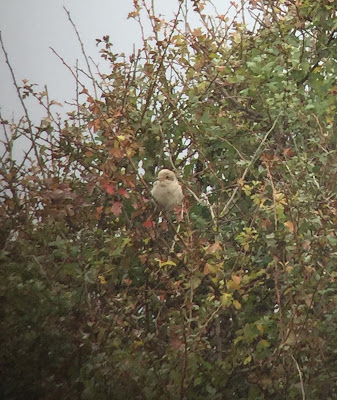

Woodchat Shrike


So, after filling our boots it was a yomp back to the Obs for something to eat. After lunch we headed out to Kilnsea Wetlands. There were still a few heavy showers about, and the easterly wind was strengthening so passerines were hard to come by and we reckoned that the hide on the wetlands might be the best bet to see a few birds and remain sheltered. In the hide we met another regular and got chatting. I mentioned I'd seen a large flock of Golden Plover and he decided to go and check them through, having missed an American Golden Plover at Spurn last year in a similar flock. We sat around a bit longer watching the Greenshank (a Spurn tick for me) and then headed back to the Obs. Five minutes from the Obs a message came over the radio that he'd found a juvenile American Golden Plover, so it was a dash to the car and then off to see the bird. To be honest it wasn't the best view. The bird was distant, was back on and well hunkered down in what was a stiff wind, and it only occasionally lifted and turned its head. It was clearly smaller and greyer than the other birds, but not as distinctive as I'd expected. 

Day two dawned uninspiringly. The wind was still strong, and squally showers didn't encourage us. But, we headed out towards Sammies to cover the lanes, reckoning that any migrants would be seeking the shelter behind or in the hedges and feeding on sheltered field margins. We counted a good number of Redwings, Song Thrushes, Robins and Fieldfares and then a shout came of a Radde's Warbler near Sammies car park. A lifer for Rob and a bird I've not seen in a long while. Unfortunately despite hanging around in some horizontal rain showers, and the bird being re-found, albeit away from its original spot, in a seemingly confined area, it did a disappearing act.

We headed back for some lunch, calling at Easington Cemetery en-route where we counted loads of Bramblings, a Common Redstart and multiple Robins. After lunch we headed out round the Triangle. We only got as far as the Churchyard where we spent some time as it was sheltered, when I found a Pallas's Warbler. It wasn't a new bird, but it was my first 'self found' so I was feeling pleased with myself when a couple of regulars turned up to have a look at it. Then all hell broke loose.

A radio message from Lance Degnan went something like this (whispered): "All birders, listen carefully. I've got a Siberian Accentor at the back of the old School House on Vicars Lane!" That's as much as I heard as we all just ran. I totally forgot about Rob who, never having experienced anything like this before, was, I think, quite bemused. I suddenly realised my car was a few minutes away at the Obs and, I had no idea where I was going, so I just shouted to ask Adam, a regular, for a lift. Thankfully Rob and I, plus a couple of others all managed to get in the car and raced off to see the bird. We were there within 10 minutes of the call going out and, well, WOW!
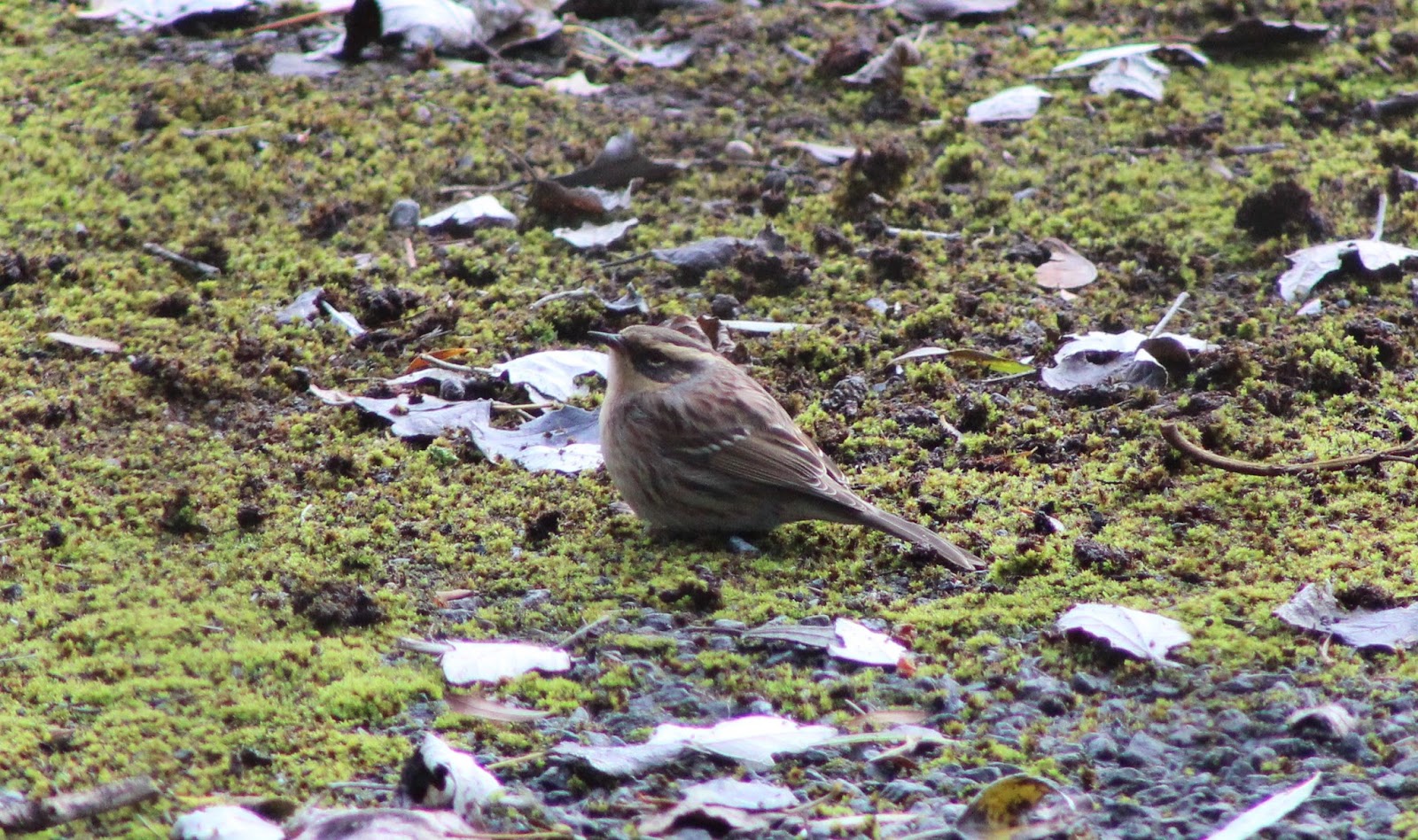
For a relative of our lowly Dunnock this bird was a stunner and very obliging, feeding down to less than 20 feet away. A second for Britain, first for the mainland, British tick for everyone there I think (don't think anyone twitched the Shetland bird) - and a lifer even for some of those who keep world lists.


Siberian Accentor


I rattled off hundreds of shots and am still going through them. There are better out there on the internet, but these will do me fine!! There was much celebrating later on in the Obs and in the Crown and Anchor!

Next morning saw Rob and I volunteering to help manage the crowds that turned up. Rob collecting donations and me parking cars to try to prevent birders causing chaos in the village. We were busy from 06:30 until about 09:30 when it seemed to calm down so we went back to the Obs for a bite to eat and a brew. I had started to come down with a cold and was really feeling it, and Kilnsea and the whole area was crawling with birders - crowds for a Firecrest and Yellow-browed Warbler sort of summed it up. I really didn't feel like spending the day dodging crowds so asked Rob if he minded leaving early. Thankfully he was ok with that, but just then a Dusky Warbler was caught and was being shown in Church Field. We went for a look, and this more than anything confirmed that I'd be leaving sooner rather than later. There must have been 200 birders queuing to see it. On the plus side it added even more funds to the Observatory coffers.


Firecrest and Yellow-browed Warbler Crowd

Its easy to get side-tracked by the rarities on a visit like this, but the commoner stuff is great too. The number of Bramblings was probably the most I've ever seen anywhere, Ring Ouzels and Shorelark as supporting cast just goes to show what an amazing place Spurn can be.


 Siskin

 Brambling
 Song Thrush