This is my first post in ages, mainly because I haven't been birding that much unfortunately. Its a shame I'm prompted to write because of something negative.
I am conflicted.
I have been a member of the RSPB for something like 20 years or more and I was a member of the Young Ornithologists Club before that. So, apart from those teenage years where beer and girls and nightclubs took over, I think its fair to say I have been a member for nigh on 50% of my time on the planet. I have flirted with membership of other environmental organisations over the past 20 or so years, but have always maintained my RSPB membership as it reflected my first, and still my main interest - birds, and so I have continued to pay my subs.
A while ago I started to have doubts about the aims of the RSPB. Not the fact that they were focussing more on all wildlife, I think thats sensible. No, it was their reluctance to really take a stand on persecution of raptors, and specifically Hen Harriers. However I continued to give them the benefit of the doubt; trusting that they knew what they were doing as well as the other perceived benefits of supporting such an organisation. Namely the way they protect vast areas through their reserves, and also by campaigning and working to protect the wider environment.
Unfortunately, today my membership hangs even more in the balance.
The Yorkshire Wildlife Trust (YWT) have submitted a planning application to construct a visitor centre at Spurn National Nature Reserve. It is something that I fundamentally disagree with, as do numerous others, including Spurn Bird Observatory Trust and many of the local residents. My objection to the plans are not 'nimbyism'. They are based on my knowledge of the area, having visited twice a year for 20 or so years, my knowledge as a birder and (perhaps most importantly) my knowledge and experience as an environmental professional who has spent the last 18 years working in conservation and ecology related fields. Neither are mine or others objections against a centre per se, but the chosen location. I feel it is the wrong location and there were/are other alternatives. However YWT went ahead with their application and I have objected to it.
So what has this got to do with the RSPB? Well today they have made a post here that to me means that the RSPB have no objection to this centre. Quite honestly I am dumbfounded. I support the organisation on the basis that they are primarily a bird protection charity but also an organisation that campaigns to protect habitats and wild areas. Spurn ticks all those boxes. It is massively important for birds, it is a protected site under UK legislation and it is a comparatively 'wild' area. Even if you disagree with the wild factor, two out of three aint bad as the saying goes. By the YWTs own admission, they are hoping to bring in upwards of 40,000 people into an incredibly sensitive area. Thats 20,000 or so more than currently visit, and the RSPB are happy that a package including signage and roving wardens is enough to protect such a sensitive area? I'm sorry but that is too much for me to take and I really do wonder why I should continue to support them as they do not reflect my views as things stand.
Its sad really. I had flirted with joining YWT for years, but following recent events there's no chance of that. I am also now seriously considering my membership of the RSPB. Two environmental charities that depend on their memberships - one that will never get my money and the other at risk of losing it.
There is still a chance that East Riding Council will refuse permission - my fingers are crossed. Ultimately it shouldn't depend on whether the RSPB support it or not, it should be down to whether the development is in line with the policies covering that area. We'll see what happens. I guess its 50:50 which is slightly better odds that the RSPB have of retaining my membership.
Wednesday, 24 February 2016

Saturday, 7 November 2015
Memories
I first visited Martin Mere about 35 or 36 years ago, around about this time of year, with a few school friends and a couple of teachers; the latter were both extremely influential and encouraged me in my formative birding years. My over-riding memory from that day was walking into the then named Millers Bridge hide to the sight of my first ever Marsh Harrier quartering the marsh less than 50 metres away. It is a memory that has stayed with me ever since - along with the faces of some adult birders who were less than impressed with half a dozen or so over excited schoolboys.
I didn't really visit again until I could drive seven or eight years later, and since then I have visited more or less every year. As with any reserve some visits are great, some are average and some are...forgettable. This time of year is when I would be expecting a good day, and thankfully, my visit today was on the good side of average even though the weather was distinctly not.


I didn't really visit again until I could drive seven or eight years later, and since then I have visited more or less every year. As with any reserve some visits are great, some are average and some are...forgettable. This time of year is when I would be expecting a good day, and thankfully, my visit today was on the good side of average even though the weather was distinctly not.

The view from the Ron Barker hide this morning: Grim.
As always, I headed straight for the old Millers Bridge Hide, now called the Ron Barker hide. I guess its a habit that links back to that very first visit and today, incredibly, was an almost exact replica of that day 35 years ago. As I walked in to the top level of the hide, there in front of me, less than 50 metres away was a cream capped Marsh Harrier! Sadly I wasn't quick enough with the camera. It wasn't the only one though, a total of four were seen, and I had three in view at the same time at one point. Sadly all bit distant for the camera though. I really must get some sort of digiscope attachment.
Masses of Pink-footed Geese were moving onto and around the reserve along with plenty of Whooper Swans which are here in bigger numbers than those seen by the Autumn watch crew at WWT Caerlaverock recently. As always Teal were here in their hundreds and I grilled every one checking for a Green-winged, ultimately without success. Another birder informed me that one had been present which just annoyed me as I couldn't find it!
Whooper Swan

After an hour or so I moved round to the other hides overlooking the main mere. I always find this a bit of a strange experience as its difficult to keep in mind that the birds here are wild. The feeding encourages birds to within feet of the hides and its not just the ubiquitous Mallard. Pintail, Wigeon, Teal, Shelduck, Pochard. All down to a few feet away. What was obvious today was the lack of the latter species, reflecting the recent news that Pochard populations seem to be crashing. I always remember the Mere being stuffed with this handsome diving duck. There was also good numbers of Ruff around the edges and quite a few Greylag Geese, a few of which were wearing neck collars.
The Mere, at Martin Mere


Thankfully my favourite and second favourite ducks were both present. Pintail, my second favourite, were around in small numbers but sadly too far away for a photo. My favourite duck did come close enough though!
Wigeon - males


Wigeon - male and female

Wigeon female -
The head shape of this species shown clearly here is something I find really useful in identifying distant birds.

I absolutely love Wigeon. It's my favourite duck. I love their plumage - both sexes are beautiful; the female is just so subtle and the combination of colours on the males is stunning - cream, chestnut, grey, black and white shouldn't really work though should it? I love their calls too. The whistle is evocative of coastal marshes and is a quintessential sound of winter on the coast, and the growl of the female always surprises me even though I know it well. I even love their shape. They just seem better proportioned than other ducks, and their head shape is so distinctive you can identify a wigeon miles away without any plumage detail being visible.
I finished the day with a visit to the Harrier Hide, which is always a disappointment for some reason, and today was no exception, and then onto the United Utilities Hide. This last hide provided no new day ticks, but I did get more excellent views of Marsh Harriers and Pink-feet before the rain came back and I decided to call it a day.
Martin Mere is a fantastic reserve. Well worth a visit, especially if you take in the wildfowl collection. For wild birds autumn and winter is best, in my opinion. I have yet to do one of the swans by floodlight events, but imagine that on its own would be worth the entry fee.
Friday, 9 October 2015
Great few days, but my timing is awful!
I spent Wednesday to Friday this week with a friend of mine at Spurn Bird Observatory, a place I visit regularly, but not often enough.
Last Sunday I was getting quite excited, there were good birds at Spurn, and the weather forecast was looking good for a fall of birds sometime around Tuesday or Wednesday. By Tuesday evening the picture had changed and although the weather forecast was for a pleasant few days, it didn't look great for birds.
When we arrived at around 08.30 the area was covered in a thick fog and visibility was down to a few hundred metres. Thankfully it soon lifted and the day turned out to be pleasant both weather and bird wise. A walk around the triangle produced a few Ring Ouzels and my first Fieldfares of the year. There were plenty Goldcrests and a few Chiffchaffs and Yellow-browed Warblers, although we didn't catch up with any of the latter. After lunch we headed out to the riding school to try to see the Red-backed Shrike that had been reported. Thankfully we were successful and managed to see this bird less than 200m or so from where I saw my first ever adult male Red-backed Shrike in the UK about 15 years ago. Later that evening after we had basically put our feet up for the day, a call came out on the radio that there was a Red-footed Falcon over Clubleys field at the back of the Warren Cottage. It took me about 40 seconds to grab my bins and slip my boots on and get outside, but it wasn't quick enough. Thankfully a minute later it was reported again just up the road in Church field, perched on wires. We jumped into the car and shot off up the road, along with other birders staying at the Obs. Just as we got to where the bird had been seen, news came out that it had moved on again. I decided to turn us back round and head back towards the Warren as most things at Spurn are moving South. Just past Southfield Farm we saw a regular Spurn Birder pulled over near 'Walker Butts' so stopped to see if he had seen anything. Sadly he hadn't but we stood chatting for a few minutes discussing likely options. A second Spurn regular was sat in his van just behind us. The first birder decided to call time and move on to look elsewhere, but we resolved to give it a bit longer. I was glad we did. Literally two minutes later, I turned around to see the Red-footed Falcon sweep over the other birders van, across the road and out over Walker Butts. I quickly put it out onto the radio which resulted in a scramble of birders back to where we were stood. It was reported again moments later quite a way north, but moving back south, but it then disappeared. Sadly, despite several sightings of 'small' falcons' there was no further confirmed sighting that day. However for me and my mate it was a great end to the day.
Day two started bright and chilly, and we decided to start with some 'vis - migging' at 'Numpties'. If you don't know what 'vis-migging' is, it is basically short for visible migration watching, where you stand and count the migrating birds passing over a particular point.

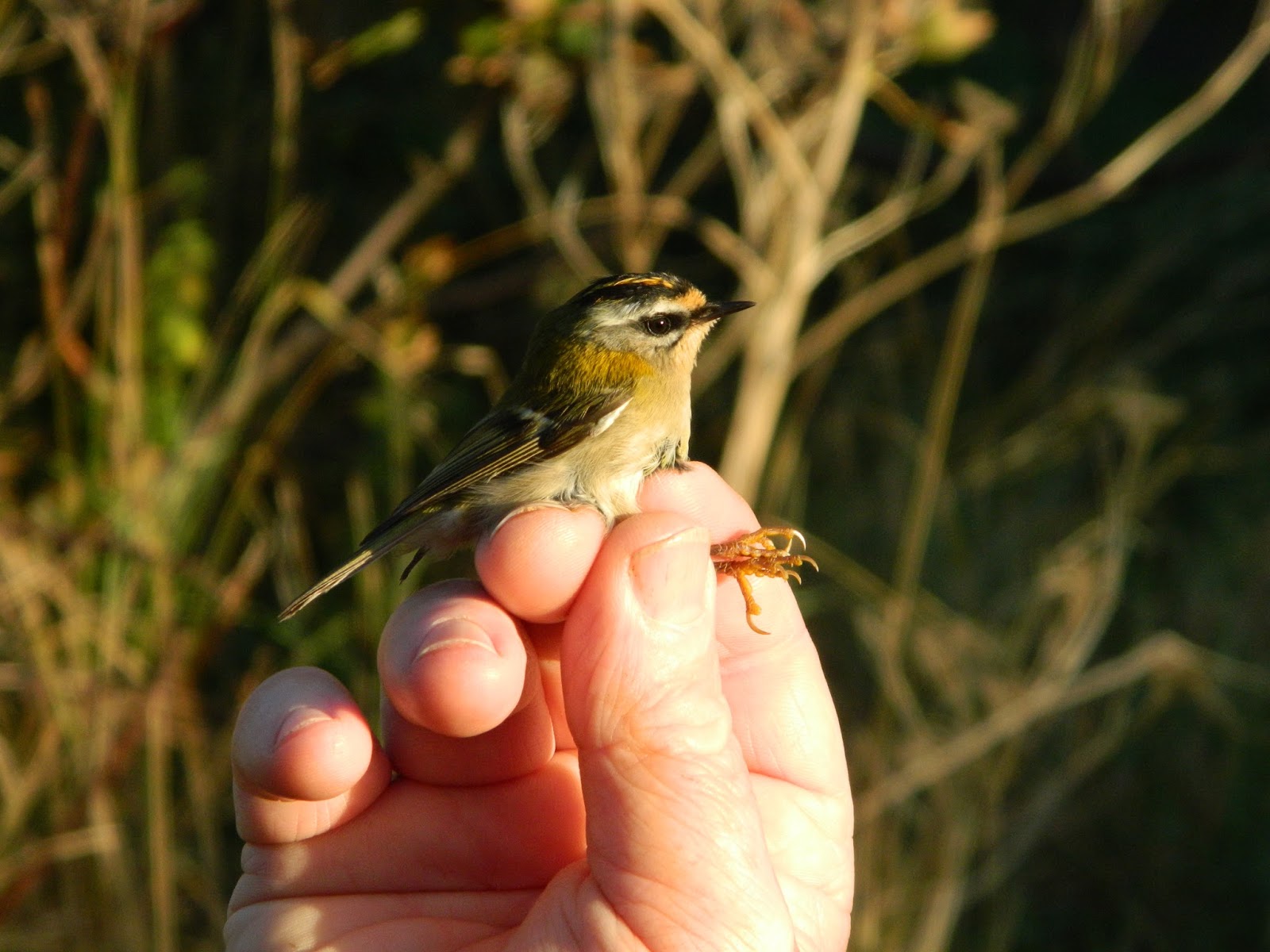
There were good numbers of common birds moving, and we also had Lapland Bunting and Richard's Pipit. The best bit though was when the Observatory Warden shouted that he had caught a Firecrest and would be releasing it after ringing it. These birds are stunning little creatures as you can see below.


The day did become somewhat less productive though, and we ended up spending about two hours in the afternoon looking for a Barred Warbler with 15 - 20 other birders. I saw its bill!
We started our final day by 'vis-migging' again at Numpties. We were out at first light and witnessed a beautiful sunrise.


Despite unsuccesfully chasing a Little Bunting the site was quiet for birds, but crawling with people, so we decided to call it a day and head home. A few of the regulars were kind enough to point out that the weather looked excellent for weekend and into next week. I thanked them for their information!!!! Spurn is a wonderful site, and the work that the Observatory do is brilliant. At the moment they are trying to secure funding to help them with the purchase of a new Observatory building, as the current one is at risk of disappearing into the sea, and is also a touch too small. Please visit the Spurn Bird Observatory Website to see how you can help them achieve this if you feel able and inclined.
Last Sunday I was getting quite excited, there were good birds at Spurn, and the weather forecast was looking good for a fall of birds sometime around Tuesday or Wednesday. By Tuesday evening the picture had changed and although the weather forecast was for a pleasant few days, it didn't look great for birds.
When we arrived at around 08.30 the area was covered in a thick fog and visibility was down to a few hundred metres. Thankfully it soon lifted and the day turned out to be pleasant both weather and bird wise. A walk around the triangle produced a few Ring Ouzels and my first Fieldfares of the year. There were plenty Goldcrests and a few Chiffchaffs and Yellow-browed Warblers, although we didn't catch up with any of the latter. After lunch we headed out to the riding school to try to see the Red-backed Shrike that had been reported. Thankfully we were successful and managed to see this bird less than 200m or so from where I saw my first ever adult male Red-backed Shrike in the UK about 15 years ago. Later that evening after we had basically put our feet up for the day, a call came out on the radio that there was a Red-footed Falcon over Clubleys field at the back of the Warren Cottage. It took me about 40 seconds to grab my bins and slip my boots on and get outside, but it wasn't quick enough. Thankfully a minute later it was reported again just up the road in Church field, perched on wires. We jumped into the car and shot off up the road, along with other birders staying at the Obs. Just as we got to where the bird had been seen, news came out that it had moved on again. I decided to turn us back round and head back towards the Warren as most things at Spurn are moving South. Just past Southfield Farm we saw a regular Spurn Birder pulled over near 'Walker Butts' so stopped to see if he had seen anything. Sadly he hadn't but we stood chatting for a few minutes discussing likely options. A second Spurn regular was sat in his van just behind us. The first birder decided to call time and move on to look elsewhere, but we resolved to give it a bit longer. I was glad we did. Literally two minutes later, I turned around to see the Red-footed Falcon sweep over the other birders van, across the road and out over Walker Butts. I quickly put it out onto the radio which resulted in a scramble of birders back to where we were stood. It was reported again moments later quite a way north, but moving back south, but it then disappeared. Sadly, despite several sightings of 'small' falcons' there was no further confirmed sighting that day. However for me and my mate it was a great end to the day.
Day two started bright and chilly, and we decided to start with some 'vis - migging' at 'Numpties'. If you don't know what 'vis-migging' is, it is basically short for visible migration watching, where you stand and count the migrating birds passing over a particular point.

There were good numbers of common birds moving, and we also had Lapland Bunting and Richard's Pipit. The best bit though was when the Observatory Warden shouted that he had caught a Firecrest and would be releasing it after ringing it. These birds are stunning little creatures as you can see below.
Firecrest

The day did become somewhat less productive though, and we ended up spending about two hours in the afternoon looking for a Barred Warbler with 15 - 20 other birders. I saw its bill!
We started our final day by 'vis-migging' again at Numpties. We were out at first light and witnessed a beautiful sunrise.
Sunrise at Numpties


Despite unsuccesfully chasing a Little Bunting the site was quiet for birds, but crawling with people, so we decided to call it a day and head home. A few of the regulars were kind enough to point out that the weather looked excellent for weekend and into next week. I thanked them for their information!!!! Spurn is a wonderful site, and the work that the Observatory do is brilliant. At the moment they are trying to secure funding to help them with the purchase of a new Observatory building, as the current one is at risk of disappearing into the sea, and is also a touch too small. Please visit the Spurn Bird Observatory Website to see how you can help them achieve this if you feel able and inclined.
Monday, 28 September 2015
The Wiggin Tree
The Wiggin Tree, aka the Rowan, Mountain Ash or Sorbus aucuparia is one of my favourite trees.
It may not have the stature of the Oak or the Ash. It doesn't support the great number of invertebrates that the Oak does, and its wood is not, as far as I'm aware used to create products such as the Willow (cricket bats) or the Yew (longbow). But, the change that it undergoes in autumn is, in my opinion subtle but stunning and one of the best of any tree. The greens, golds and browns contrast so beautifully with the vivid red of the berries.


Not only that of course, but it has links to my home town of Wigan. It appears on the town's crest as well as on the badge of my beloved Wigan Athletic. Reason enough to like it if there were no others.
At the moment young Wiggin Trees are obvious all around my usual dog walking route. I'm hoping that the good berry crop will attract plenty of winter thrushes to give me something else to enjoy once the autumn colours have faded.
It may not have the stature of the Oak or the Ash. It doesn't support the great number of invertebrates that the Oak does, and its wood is not, as far as I'm aware used to create products such as the Willow (cricket bats) or the Yew (longbow). But, the change that it undergoes in autumn is, in my opinion subtle but stunning and one of the best of any tree. The greens, golds and browns contrast so beautifully with the vivid red of the berries.
The Wiggin Tree


Not only that of course, but it has links to my home town of Wigan. It appears on the town's crest as well as on the badge of my beloved Wigan Athletic. Reason enough to like it if there were no others.
At the moment young Wiggin Trees are obvious all around my usual dog walking route. I'm hoping that the good berry crop will attract plenty of winter thrushes to give me something else to enjoy once the autumn colours have faded.
Sunday, 27 September 2015
Lancashire Coastline
I booked a day off last Friday with the intention of spending day over on the east coast, Flamborough Head specifically. Unfortunately the weather gods were against me, and the idea of sitting in the car for 2 1/2 hours to spend a day on the east coast in westerly winds was, well, not attractive.
So, in the end I went for a trip onto the Lancashire coast instead.
I started the day at a new spot - Pilling on the north coast of the Fylde, overlooking Morecambe Bay.

So, in the end I went for a trip onto the Lancashire coast instead.
I started the day at a new spot - Pilling on the north coast of the Fylde, overlooking Morecambe Bay.

Looking out onto the saltmarsh at Pilling. Heysham Nuclear power station is visible over my scope.
High tide was forecast at 08:15, but it would only reach 7.5 metres so I wasn't expecting masses of birds close in. But I did expect a few birds moving around, and maybe a few Pink-footed Geese as this is a regular haunt with over 10,000 present during winter. I arrived at around 07:45 at the Environment Agency car park on Backsands Lane (a great little spot as you can bird from the back of your car, and its free) and got set up. Although it was bright it was more than a little chilly, and the NW wind was biting. It was also quiet. Very quiet. A few Curlew were close in, and four Little Egrets were nice to see - it still amazes me that these birds are now relatively easy to see - when I did the annual bird race in Lancashire in 2003, a Little Egret was a real bonus. Anyway, there were a few pink-feet, 10 to be precise, plus another 22 over southbound, which were the first of the autumn for me. At one point I had 10 pinks in the 'scope, a Swallow over their heads and Chiffchaff singing in the tree behind me. Quite a strange mix. 580 Shelduck and 1000+ Teal gave me something to count, but most things were so distant, and the haze so bad I decided to call it a day after 1 1/2 hours.
So, I headed off back towards home, but with a detour off to Marshside RSPB. On arrival I went straight to the main hide/visitor centre to check the log. It was telling that there was nothing - I mean nothing - visible from this hide. So, I walked across the road onto the marsh and found a spot out of the wind at the back of the old sand winning plant. Again the place was almost birdless. A few Snipe and Lapwings were the first birds I noticed, followed again by 3 Little Egrets. I really hoped for a Peregrine or a Merlin but it wasn't to be. Instead I spent a very quiet but strangely rewarding hour watching the antics of the Lapwings and the Snipe and practicing my sketching skills. At 2pm, with nothing at all on Twitter I decided to knock it on the head and headed home. On the plus side, there was nothing on the east coast either and so I saved myself a fair old drive and a few quid in diesel.
Monday, 31 August 2015
Bonelli's Warbler in Greater Manchester
Around 15.00 this afternoon I received a text from a friend telling me a Bonelli's Warbler (no one had confirmed whether it was eastern or western) had been found on Billinge Hill, about 15mins from my house. The original report stated the bird was in St Helens, but I know the county boundary runs along the top of Billinge Hill, so I was hopeful the bird would actually be in GM.
On arriving at the site it was absolutely teeming down, so I sat in the car for 10mins or so. The copse it was reported to be in was only a five minute walk from the car, and there were several birders already there looking for the bird. I met up with a couple of birders I know from St Helens, and had a good chinwag in the absence of the Bonelli's. The copse was mainly pine with only a few deciduous trees, and the gen was that the bird had moved through the copse, and probably off along a hedgerow leading north or east.
I left after an hour or so when the rain started again. Sadly it had not been relocated last time I heard, but it was confirmed the bird was in GM and not St Helens, Merseyside. It would be fantastic if it were re-found but especially if its in GM.
On arriving at the site it was absolutely teeming down, so I sat in the car for 10mins or so. The copse it was reported to be in was only a five minute walk from the car, and there were several birders already there looking for the bird. I met up with a couple of birders I know from St Helens, and had a good chinwag in the absence of the Bonelli's. The copse was mainly pine with only a few deciduous trees, and the gen was that the bird had moved through the copse, and probably off along a hedgerow leading north or east.
I left after an hour or so when the rain started again. Sadly it had not been relocated last time I heard, but it was confirmed the bird was in GM and not St Helens, Merseyside. It would be fantastic if it were re-found but especially if its in GM.
Delayed Holiday Post!!
I have just (well, two weeks ago now) returned from a wonderful family holiday in the Algarve, Portugal. We stayed in the Albufeira Sol in the 'new' bit of the town, and if anybody is thinking of staying there I can recommend it as a family hotel. The food was also excellent. As this was our annual family holiday I didn't try to do too much birding. That's often the case on our family holidays - usually I just end ip finding some suitable habitat nearby and birding there as a 'local patch' for a couple of weeks. This time unfortunately there was nothing really suitable nearby which was disappointing.
The saving grace however was the fact that we didn't have a pool view. In fact some would have been a bit miffed with the view that we had but I was well chuffed. As you can see in the photo's we were looking out over a rough patch with a few lime trees and scrubby bushes, and it was from our balcony that I did all my birding. Considering the limited opportunity I was more than happy with what I saw in a half hour or so each morning.


House sparrows and collared doves were ubiquitous. However the first good bird was a crested lark that perched up on the old farm buildings. This was swiftly followed by a good number of red-rumped swallows feeding around the villa opposite. Sardinian warblers seemed like they were in every bush. The two big highlights though were the appearance of 8 or so azure-winged magpies and a juvenile woodchat shrike in the lime trees. I had fantastic views of both, if a little distant. The red-rumped swallows came so close and were so numerous that I spent quite a bit of time studying the variable colouration of the rumps. Some 'rumps' do indeed look white (as per the field guide comments) whilst others are very definitely red. They are also quite different in their 'jizz' compared to barn swallows; I just hope I manage to remember that next time I'm at Spurn watching the swallows whizz past.


When we were sat in the airport waiting to board the plane on the outbound journey, I received a text from a friend telling me he had found a sabine's gull at Pennington Flash - a local patch of mine. This bird would have been a patch tick as well as a borough and county tick for me so I was really gutted to have missed it, but made up for the finder. All the time I was in Portugal I was checking the news feeds and manchester birding website whenever I had WIFI access, and amazingly, the bird was hanging around. I was hoping beyond hope it might just hang on until I returned. Remarkably it was still present the day I got home, so as soon as we dropped the cases off at home I grabbed my 'bins and shot off to Pennington Flash. I'm not generally a lover of gulls, but this little larid is a stunner, especially in flight. I only had a few minutes to watch it - a twitch and run visit. I had hoped to get back to grab some shots, but it left before I could return.
The saving grace however was the fact that we didn't have a pool view. In fact some would have been a bit miffed with the view that we had but I was well chuffed. As you can see in the photo's we were looking out over a rough patch with a few lime trees and scrubby bushes, and it was from our balcony that I did all my birding. Considering the limited opportunity I was more than happy with what I saw in a half hour or so each morning.


House sparrows and collared doves were ubiquitous. However the first good bird was a crested lark that perched up on the old farm buildings. This was swiftly followed by a good number of red-rumped swallows feeding around the villa opposite. Sardinian warblers seemed like they were in every bush. The two big highlights though were the appearance of 8 or so azure-winged magpies and a juvenile woodchat shrike in the lime trees. I had fantastic views of both, if a little distant. The red-rumped swallows came so close and were so numerous that I spent quite a bit of time studying the variable colouration of the rumps. Some 'rumps' do indeed look white (as per the field guide comments) whilst others are very definitely red. They are also quite different in their 'jizz' compared to barn swallows; I just hope I manage to remember that next time I'm at Spurn watching the swallows whizz past.


Rubbish shots of Red-rumped Swallow
When we were sat in the airport waiting to board the plane on the outbound journey, I received a text from a friend telling me he had found a sabine's gull at Pennington Flash - a local patch of mine. This bird would have been a patch tick as well as a borough and county tick for me so I was really gutted to have missed it, but made up for the finder. All the time I was in Portugal I was checking the news feeds and manchester birding website whenever I had WIFI access, and amazingly, the bird was hanging around. I was hoping beyond hope it might just hang on until I returned. Remarkably it was still present the day I got home, so as soon as we dropped the cases off at home I grabbed my 'bins and shot off to Pennington Flash. I'm not generally a lover of gulls, but this little larid is a stunner, especially in flight. I only had a few minutes to watch it - a twitch and run visit. I had hoped to get back to grab some shots, but it left before I could return.
Subscribe to:
Posts (Atom)