Friday, 7 October 2016

East Coast Gems


I had been watching the recent weather intently. As a birder you're always interested in the weather and it had looked good the last few days with a high pressure over Scandinavia producing great migration conditions, and a few rarities around the country showed that birds were moving. I was partly watching the forecast in dread too; I'm off to Spurn next week and I'm praying that if the high pressure stays it doesn't all 'happen' before I get there, and if it moves off I don't want to be there in a westerly or north westerly. Anyway, the rarities kept cropping up along the east coast and I've been sat watching jealously, so when a colleague at work said he was off to the east coast on Thursday (yesterday) and asked if I fancied it I nearly bit his hand off. I just had to make a few calls to get meetings re-organised and I was sorted. I was in work on Wednesday and news started trickling through of even more good birds - Eastern Crowned Warbler, Greenish Warbler and the Black-Browed Albatross at Bempton RSPB, Whites Thrush on Holy Island, Red-flanked Bluetail and Little Bunting at Spurn, plus Yellow-browed Warblers pretty much everywhere. I was like a kid at Christmas and couldn't wait, as several of my work colleagues pointed out.

05:30 on Thursday and I was on my way, and being chauffeured by Dermot. The first time in years I haven't had to drive over to that side of the country so that was an added bonus. As we crossed the Pennines I was keeping an eye on the news so we could finalise our day. We were definitely going for the Eastern Crowned Warbler (ECW) and were considering going for the White's Thrush on Holy Island too, but were trying to remain flexible. At about 08:20 we turned into the car park at Bempton. There were already plenty of cars around and a few birders walking towards the scrubby area at the side of the new Seabird Centre. We quickly joined them and learned that the bird had been showing quite well already, so took up position just outside the canopy. Sure enough after about 10 minutes the bird appeared and what a cracker. I can understand how, with only brief views, someone could mistake this for an Arctic Warbler, but with a good view this bird is so distinctive. In some lights the head was almost black and the faint greyish crown stripe was easily picked out. The bird was very active and moved around constantly and my attempts to photograph it failed miserably. I did however manage a nice shot of a Tree Sparrow!! There was also a huge number of Chiffchaffs in the bushes with a nice array of plumages on display, from buff to green, small medium and large superciliums, they were all on display. A nice Brambling that had obviously just arrived was also a nice addition to the list.
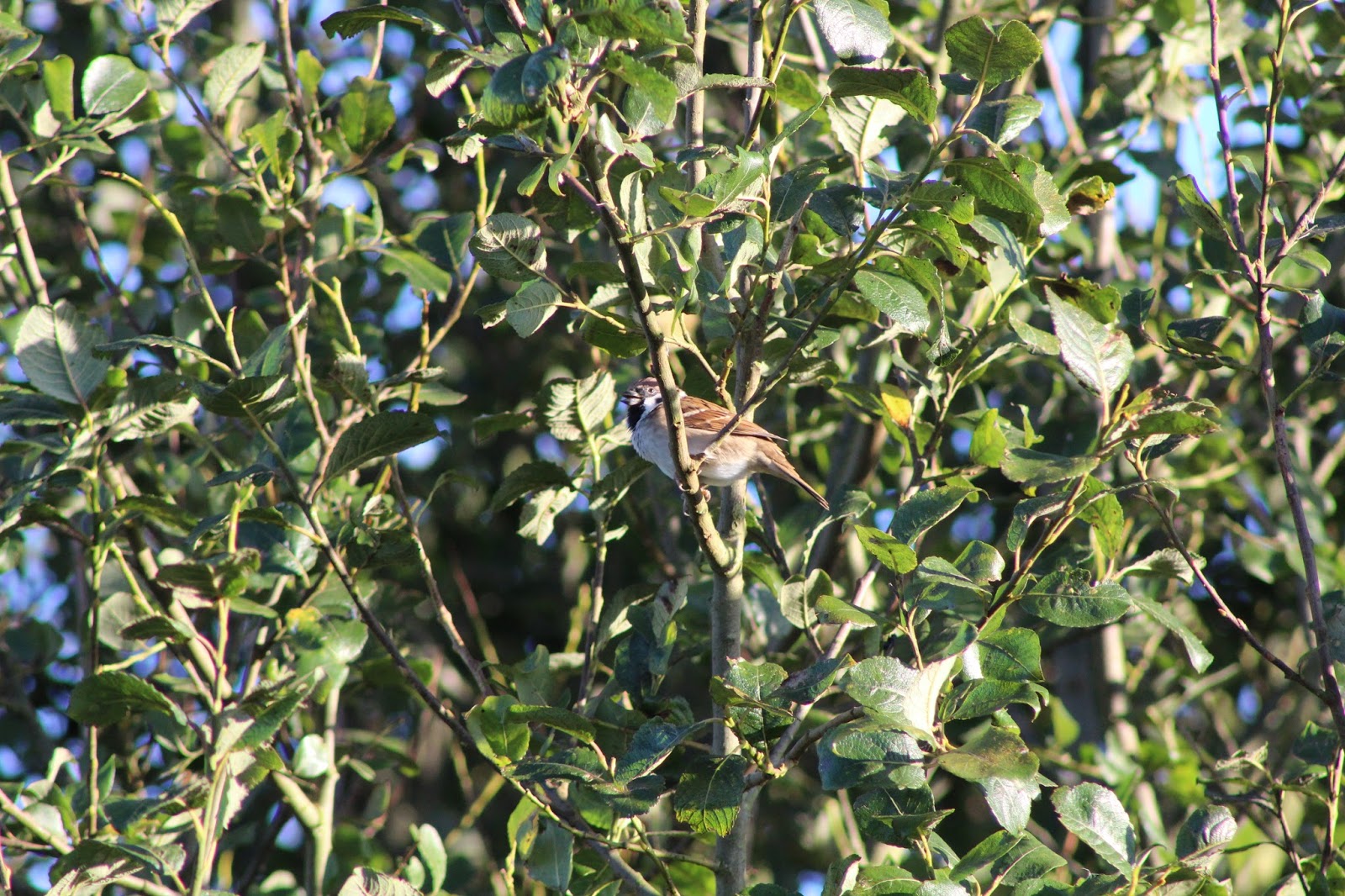
Tree Sparrow

After watching the ECW for a while we mooched around the reserve, a quick look on the sea proved fruitless, mainly because it was so breezy I couldn't keep the scope still, but there were still plenty Gannets and Fulmars close in to provide a bit of entertainment. We were heading back to the car when reports came through of a Bluethroat on the coastal path so we headed back to see if we could see it. It was eventually pinned down between two crowds and I managed reasonable views of a first winter/juvenile type bird. I was amazed so many people had rushed to see it, probably just due to the number of people on site for the ECW, anyway, it was enough to encourage us to leave. The White's Thrush had done a disappearing act, so it was off to Flamborough for the Taiga Bean Goose. A quick word about Bempton Cliffs RSPB. There has been a tremendous amount of work done since I was last here in 2014. The new seabird centre is a huge improvement on what was there before, the paths around the reserve have been massively improved too as has the car park. Go check it out.

We picked up the Taiga Bean Goose quite quickly, and even though it was distant we got good views of the distinguishing features. We then had a quick debate about what to do next. Nothing new had come up on twitter so we decided that Spurn had to be a good option and set off. We'd just called for fuel in Hornsea when I had a twitter alert that an Arctic Warbler had turned up back at Bempton. A quick debate and we were heading back to Bempton. Once again we skidded into the car park, except this time we were in the overspill there were so many birders on site. We grabbed our gear and headed off in the opposite direction to the crowd still looking at the ECW. We had only just got our scopes set up when someone called a Warbler in the hedgerow. Thankfully I managed to get on it quite quickly and had an eyepiece full of what to me was clearly an Arctic Warbler. The bird flitted around in a couple of Willows then disappeared. About five minutes later a.n.other warbler appeared on top of a small Hawthorn, closer than where the first warbler had been but in the same area. I didn't get on this one, but some people said this wasn't an Arctic Warbler, more likely a Greenish. Several birders then had a lengthy debate about what had actually been seen. Both Dermot and myself were sure we had seen Arctic Warbler, as was another friend who we met on site, who also happens to be an excellent birder. After some debate the two bird theory seemed to explain it and seeing as neither bird was showing we moved back to the ECW where it was showing ridiculously well and I managed some great (for me) photos of it, along with a couple of other birds.


 Eastern Crowned Warbler
 
 Eastern Crowned Warbler
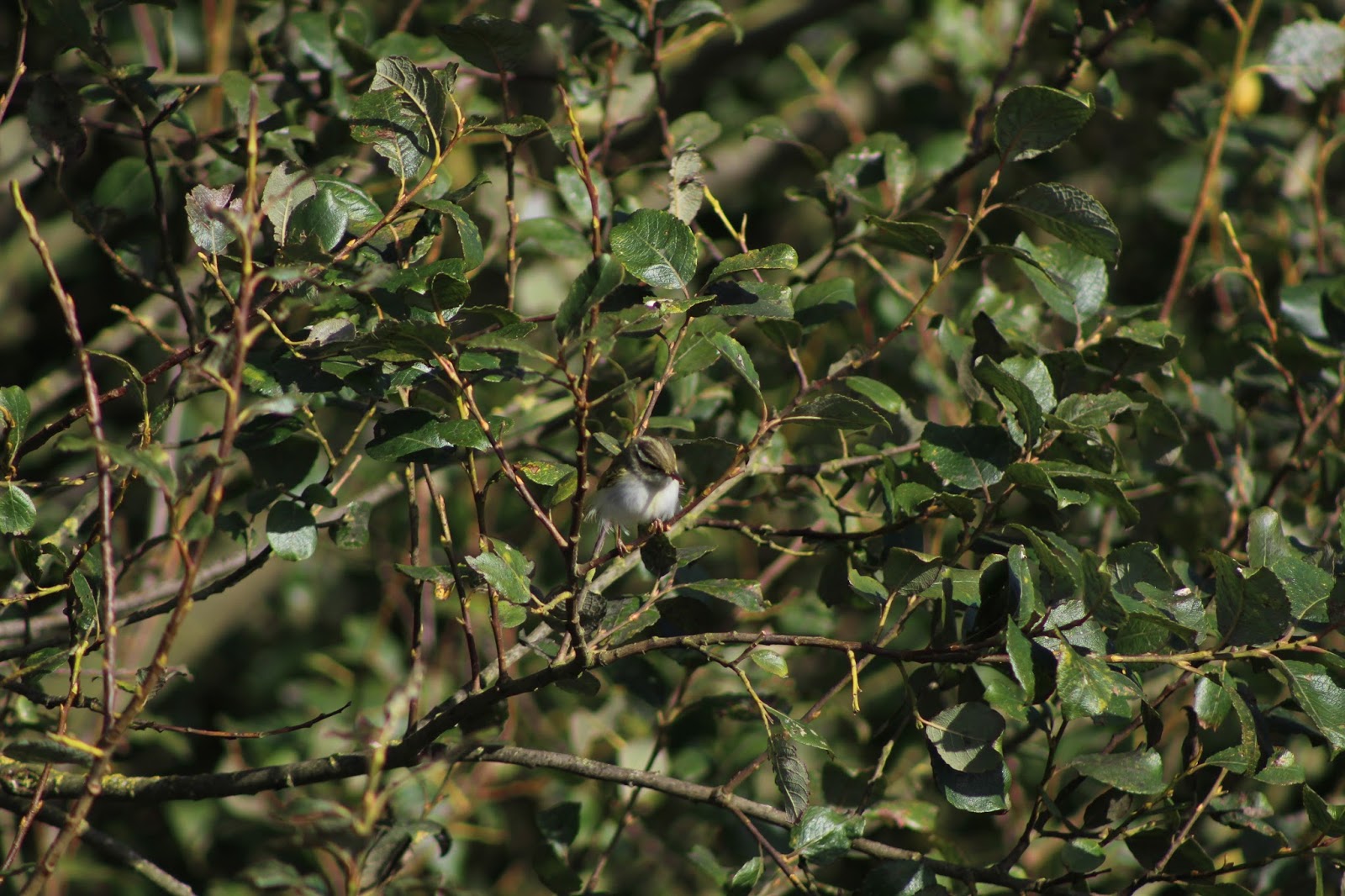
 
 Eastern Crowned Warbler
 
 Eastern Crowned Warbler
 
  Chiffchaff
 
 
 Redwing
 
 Tree Sparrow
 
We decided to have one last look over the sea before leaving. It was still breezy, and still almost impossible to hold the scope steady. Instead I watched the Gannets which just seemed to be enjoying flying in the stiff breeze. At one point just about every Gannet on the cliffs headed out to sea in one movement. It was quite breath-taking. The photo below doesn't do it justice as it was a quick snap on my mobile but it was a great way to end the day.


Saturday, 1 October 2016

Leasowe

So, the forecast for today wasn't great, but the tide was a 9m + at midday and I really fancied getting out to the coast. I thought about heading off to Parkgate or the North Wirral foreshore but I discovered that the Wirral Wader festival was on today. Nothing at all against this, in fact I think its great, but I just fancied a quiet day out and the thought of loads of people didn't encourage me. To be fair I could have gone to Parkgate as the event only started there in the evening, but I had seen reports of some decent seabirds off the northern coastline and I fancied a chance at seeing some of these with some decent wader numbers. So, I decided to head to the gun site at Leasowe as this wasn't  mentioned at all in the festival venues and it was where the reports of Leach's Petrel and Pomarine Skuas had been from. I've never been to this particular site before so had no idea what to expect.

When I arrived I was instantly happy with my choice. As well as being able to park (for free) so I could sit on the back of my car and look right onto the beach, there was also some great scrub habitat immediately inland that looked promising.

                                              Looking straight out towards the wind farm


                                             Looking North East towards New Brighton

I arrived at around 08:30 with high tide due at midday, so I spent the first couple of hours bush bashing in the scrub between the beach and golf course. Although it looked promising there was very little on show except for a lonely Chiffchaff and the usual Tits, Blackbirds and a few finches. There were however hundreds of Meadow Pipits streaming over. They were coming in on a broad front all across the coastline so impossible to count, but it was an impressive movement.

As the tide started to rise I set up behind the car. There were plenty of Oystercatchers and quite a few small mixed flocks of waders batting around, and a few Oystercatchers and Redshanks had started to roost up on the rocks just off the beach. There was also a good number of Sandwich Terns present, later joined by a few Common Terns. The pictures below are a bit dark as they were phonescoped at full zoom on the phone and by this time the weather had turned a bit grim!


A nice adult Arctic Skua was one of the birds I had hoped for, as was a Red-throated Diver, but it was really nice to see the latter sat on the sea a few hundred metres off the beach, a pleasant change from seeing them half a mile out and by far the best view I've had of one of these in ages. The photos again aren't the best and the view through the scope were much better.


                                                               Red-throated Diver

One of the most extraordinary things I saw today was what I assume was a truly huge flock of Common Scoter. I knew that there was a big number regularly seen off Holyake but this was way more than I'd imagined. There were thousands and thousands, not to mention the many flocks of 10 - 20 birds that were scattered as far as you could see. It was truly spectacular, I just wish I'd been closer.

Anyway, by midday the rain had really set in and after another hour I gave up. However I really enjoyed this spot and will probably be visiting regularly.

Saturday, 20 August 2016

Corfu 2016

I have just returned from a 10 day break on the wonderful island of Corfu.

The usual routine when we are planning our holidays, is that we all agree a country, and then my wife starts to scour the internet for suitable hotels that meet her requirements. When she's found one I have a quick look and give my opinion. That opinion is usually based on whether I can see anywhere nearby to go birding! It doesn't have to be a nature reserve, or be particularly big. Just somewhere I can go for a walk in a morning and enjoy a bit of birding while everyone else is having a lie in. So, this year when she presented me with the Aquis Sandy Beach Resort in Agios Georgios in Corfu I did the usual and had a quick look on Google Maps. I was quite excited. The hotel is right at the side of the Lake Korission Nature Reserve . And when I say right at the side, I mean my balcony overlooked its south eastern boundary.

The lake itself was approximately 1.5km west from our hotel, but was easily accessible down a couple of dirt tracks. These tracks cut through the edge of the reserve area and the habitat along these tracks, between the hotel and the lake, provided some of the best birding of the whole holiday.

South Eastern end of Lake Korission


Typical habitat around the hotel

Cedar and Juniper in the dune system

Sand dune habitat

The habitat within the main reserve was sand dunes with cedar and juniper bushes, plus some small damp areas, almost like the dune slacks we see in UK dune systems. Away from the main reserve area, the habitat along the local roads consisted of small scale agriculture, with olive groves, lime and lemon groves plus other small holdings. These areas were also productive. All my birding was done in this area as I don't hire cars when abroad, and on this holiday it didn't matter. 


European Bee Eater

On my first trip out I had 5 European Bee Eaters flying over near the small hide at the end of the lake. also had up to 5 Hoopoes, Woodchat Shrike, Red-rumped Swallow and plenty Collared Doves and House Sparrows. That was on a quick walk out mid morning to familiarise myself with the area! The next morning I was out by 06:15 and headed straight to the lake. I added Nightingale and Great Reed Warbler before I arrived at the hide where I met Chris, another British birder who was staying at the same hotel. Chris let me have a look through his scope at the waders on the lake - Kentish Plover, Common Sandpiper and Black-winged Stilt. We birded the dunes together for an hour or so seeing plenty Woodchat Shrikes and Hoopoes and getting great views of Zitting Cisticola in one of the damp areas. On my way back to the hotel I picked up 10 European Bee Eaters plus a distant Lesser Grey Shrike and Common Buzzard.

This pattern was repeated six times in the 10 days I was there, although unfortunately I didn't see Chris again whilst out birding. However we often bumped into each other in the hotel and updated each other on our sightings. Some days I included a walk along local roads which had plenty of birds in the adjacent habitats but I didn't add any new species here.


 Woodchat Shrike


 Woodchat Shrike

Woodchat Shrike (juvenile)

 Lesser Grey Shrike


Lesser Grey Shrike

Juvenile Woodchat Shrike still being fed by adults - photo taken immediately outside our hotel

Other species seen in and around the area included Great White Egret, Grey Heron, Barn Swallow, House Martin, Common Swift, Blue Tit, Great Tit, Red-backed Shrike, Subalpine Warbler, Eastern Olivaceous Warbler, Sardinian Warbler, Pied Wagtail, Jay, Carrion Crow.

Inside the hotel, up to three Scops Owls could be heard and there were some great insects with a species of Swallowtail butterfly which I think was Scarce Swallowtail, Hummingbird Hawk Moth and 1000's of Painted Lady Butterflies in the first few days as well as some different dragonflies that I couldn't identify. 

Swallowtail Spp

Painted Lady

We ventured out of Agios Georgics just the once to visit Corfu Town. I was counting on seeing Alpine Swift here and I wasn't disappointed . Throughout the day I had seen small groups of Alpine Swifts screaming above the narrow streets, their chattering call was really distinctive and reminded me a bit of the call of Little Grebe. However my biggest surprise, and arguably best birding moment of the entire holiday happened as we came out of the town onto the square near the new harbour to get our coach back to the hotel. The trees around the square were full of House Sparrows, hundreds of them, but the sky was full of Alpine Swifts. Thousands of them! I was transfixed. The photos below might give a bit of an impression of the numbers, but I had to zoom in to maximum zoom to pick out the birds as they were so high up.


Alpine Swifts over Corfu Town

It was a magical sight and I could have stayed for hours watching them wheeling and screaming through the sky.

Whilst the birding on this holiday was very enjoyable, it was also challenging as the birds tend to keep well hidden, or make themselves scarce as soon as they see you. I'm guessing its to do with the fact that the Corfiots still enjoy their hunting. The track from the hotel to the lake was littered with shotgun cartridges, although most looked quite old. As a result you really had to work to identify some birds as all you saw was brief glimpses as they crept through the vegetation, or a rear end view as they flew away from you as quickly as they could. But, that didn't detract from the experience and it was a thoroughly enjoyable holiday.

Thursday, 2 June 2016

Hymenoptera in Hiding?

I visit my local patch/dog walking patch pretty much daily, so I'm pretty tuned in to its ways. Its not exactly the most biodiverse place in the world, but its still relatively new - 20 years ago it was intensively managed farmland - so it has time yet. Flower wise, there's not usually too much to see. Buttercups, Common Spotted and Northern (I think) Marsh Orchids, Herb Robert, Cuckoo Flower and Ragged Robin are some of the most abundant species at the moment, and some have been on show in good numbers over the last few days.

Just a sample of the wildflowers around at the moment


 The photo above shows just a small patch of the flowers that are out at the moment - the main species is obviously Buttercup, but there is some Ragged Robin in there as well as the odd Cuckoo Flower and Orchid. You can see the buttercups extend well into the adjacent horse paddocks.

Hawthorn in bloom


There is also a significant bloom of Hawthorn blossom at the moment and, as most of the hedgerows were retained when the site was planted up, there's quite a bit of it about too.

These photos were taken on Bank Holiday Monday just gone, the weather was overcast with sunny spells, but it was warm and still.

So, what am I getting at? Well, with all those factors considered I would have expected to see good numbers of insects, particularly bees and hoverflies, whizzing around all over the place. I honestly didn't see a single bee. I did see a couple of Speckled Wood butterflies and two Holly Blue butterflies, but nothing on the Hymenoptera front. Even just two or three years ago this place would have been buzzing, literally, at this time of year.  I know lots of people are quite worried about the decline of bees and this just backs up their concerns.

Monday, 23 May 2016

A New Experience

Last week I was at Spurn again, staying at the Observatory. But not the old Warren Cottage. No, this was in the big, shiny new observatory building that is the future of Spurn Bird Observatory (SBO).

For those that might not know SBO has, until now, been based at the Warren Cottage. Originally there was a number of buildings, but these were condemned leaving just the cottage to accommodate visiting birders. Although I always enjoyed staying there, it could never have been called luxurious. It was old, too small, damp and chilly to say the least in winter. Having said that, I will miss it. It was also limited in the number of people it could accommodate as there were only three small rooms. Added to that, there was the inexorable march of the North Sea, which is now only about 30 metres from the back of the cottage. So,  the Observatory Committee decided to take the opportunity to purchase a detached property that became available in Kilnsea, not far from the Crown and Anchor pub (very fortunate). I know for a fact that a huge effort has been made by the Observatory and volunteers (of which I was ashamedly not one) to get the building ready for visiting birders, and what a job they have done. These pictures are just from downstairs where there is a boot room/ drying room, kitchen diner, common room, downstairs toilet and a twin room that is a bit 'special' in that it comes with bed linen provided for a small extra charge. Upstairs there are two shower/toilets and three rooms; two sleeping four and one sleeping three. You need to bring a sleeping bag or bed linen if staying in these rooms.


Common Room


Kitchen


Downstairs Bedroom


Unfortunately my photos just don't do it justice. It really is superb and if you've ever thought of staying at Spurn, but were put off by thoughts of cramped chilly nights in the Warren, think again. All the info you need is on the Spurn Bird Observatory website here, and whilst you are there why not become a friend of SBO too and get cheaper rates and contribute to the work of this fabulous charity.

Anyway, birds wise it was quiet. The weather just wasn't conducive to good passage and so it was slow. The 'rarest' bird was a Little Stint, but some of the waders in full breeding plumage were  stunning, and I spent a bit of time just 'scoping the waders on the Humber, admiring their plumage and re-familiarising myself with birds I don't get to see too regularly - Bar-tailed Godwit for example. I also amused myself trying out two new gadgets, a Canon EOS DSLR and a Phoneskope attachment for digiscoping. The photos below are a combination of digiscoped and DSLR. The difference is quite clear, but I am impressed with the Phoneskope accessory. However it is quite clear I need a fair bit of practice.

Yellow Wagtail

Yellow Wagtail

Grey Plover and Dunlin

Grey Plover and Dunlin
 

Little Egret eating a fish

Little Egret

Little Egret

Little Stint (Honest)

 
Roe Deer
 
Staying at Spurn is always a treat, and is still something that excites me even after 20 years. The 'resident' birders know their stuff and will always help out anyone new. Staying in the 'Obs' inevitably leads to new friendships, and even if its slow on the bird front, time spent just relaxing is a pleasure.

Tuesday, 3 May 2016

Still Waiting for Spring

Another long gap between posts. In no small part that has been because there has been very little to post about, on the birding front at least.

Since my last birding related post I have had several days out - Ive been up to Sizergh Castle for the Hawfinches and failed to see them, followed by possibly the quietest visit to Leighton Moss Ive ever had. I walked into Lilians Hide, which normally has plenty wildfowl on show, to see nothing. Literally nothing. I have had a few days out on the Wirral visiting the North Wirral foreshore, Burton Mere etc etc and saw not a lot at all. And, I have traipsed around my local patch pretty much every day seeing two thirds of nothing! On the plus side, Wigan Athletic have won (barring Burton experiencing a miracle) League 1 and therefore automatic promotion back to the Championship.

Anyway. I had booked today off work in case I needed to run No2 child to an audition, but as that fell through I thought I'd get out onto the moors around Horwich. I did consider a run over to the east coast, but as the wind had been in the north for the last few days, with a swing to westerly yesterday and today, I didn't reckon it would be worth the 2 hrs in the car.

Looking South from Georges Lane


I was on the moors for around 06.00 and conditions were not exactly promising. The car was showing 3 degrees and the wind was a decidedly stiff westerly. A quick whizz up to the top of Winter Hill produced just a couple of meadow pipits and the usual carrion crows, the odd skylark and a kestrel. So instead I walked along Georges Lane to see if there was anything in the meadows. Again it was quiet with nothing unusual, and a drive around some of the lanes checking for wheatears in the paddocks only produced a single pied wagtail, so it was back home for a whizz around the local patch.

This was much better, if still a bit on the quiet side, but it did provide some new birds for the year. A sedge warbler was back on territory at the small pond, and another bird was singing in a scrubby area nearby - a new territory. There where a couple of whitethroats and blackcaps around, which were also new birds for the year, as was a common swift and house martin. So although still quiet at least its started to feel a bit like spring is coming!


Wednesday, 24 February 2016

RSPB bye bye?

This is my first post in ages, mainly because I haven't been birding that much unfortunately. Its a shame I'm prompted to write because of something negative.

I am conflicted. 

I have been a member of the RSPB for something like 20 years or more and I was a member of the Young Ornithologists Club before that. So, apart from those teenage years where beer and girls and nightclubs took over, I think its fair to say I have been a member for nigh on 50% of my time on the planet. I have flirted with membership of other environmental organisations over the past 20 or so years, but have always maintained my RSPB membership as it reflected my first, and still my main interest - birds, and so I have continued to pay my subs.

A while ago I started to have doubts about the aims of the RSPB. Not the fact that they were focussing more on all wildlife, I think thats sensible. No, it was their reluctance to really take a stand on persecution of raptors, and specifically Hen Harriers. However I continued to give them the benefit of the doubt; trusting that they knew what they were doing as well as the other perceived benefits of supporting such an organisation. Namely the way they protect vast areas through their reserves, and also by campaigning and working to protect the wider environment.

Unfortunately, today my membership hangs even more in the balance. 

The Yorkshire Wildlife Trust (YWT) have submitted a planning application to construct a visitor centre at Spurn National Nature Reserve. It is something that I fundamentally disagree with, as do numerous others, including Spurn Bird Observatory Trust and many of the local residents. My objection to the plans are not 'nimbyism'. They are based on my knowledge of the area, having visited twice a year for 20 or so years, my knowledge as a birder and (perhaps most importantly) my knowledge and experience as an environmental professional who has spent the last 18 years working in conservation and ecology related fields. Neither are mine or others objections against a centre per se, but the chosen location. I feel it is the wrong location and there were/are other alternatives. However YWT went ahead with their application and I have objected to it.

So what has this got to do with the RSPB? Well today they have made a post here that to me means that the RSPB have no objection to this centre. Quite honestly I am dumbfounded. I support the organisation on the basis that they are primarily a bird protection charity but also an organisation that campaigns to protect habitats and wild areas. Spurn ticks all those boxes. It is massively important for birds, it is a protected site under UK legislation and it is a comparatively 'wild' area. Even if you disagree with the wild factor, two out of three aint bad as the saying goes.  By the YWTs own admission, they are hoping to bring in upwards of 40,000 people into an incredibly sensitive area. Thats 20,000 or so more than currently visit, and the RSPB are happy that a package including signage and roving wardens is enough to protect such a sensitive area? I'm sorry but that is too much for me to take and I really do wonder why I should continue to support them as they do not reflect my views as things stand.

Its sad really. I had flirted with joining YWT for years, but following recent events there's no chance of that. I am also now seriously considering my membership of the RSPB. Two environmental charities that depend on their memberships - one that will never get my money and the other at risk of losing it.

There is still a chance that East Riding Council will refuse permission - my fingers are crossed. Ultimately it shouldn't depend on whether the RSPB support it or not, it should be down to whether the development is in line with the policies covering that area. We'll see what happens. I guess its 50:50 which is slightly better odds that the RSPB have of retaining my membership.